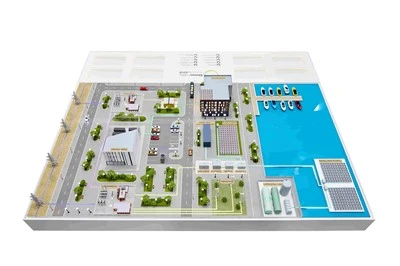
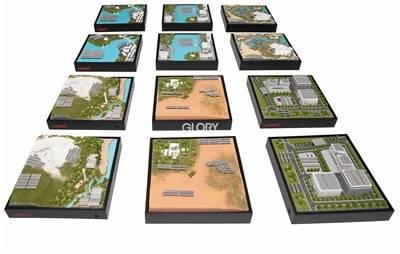
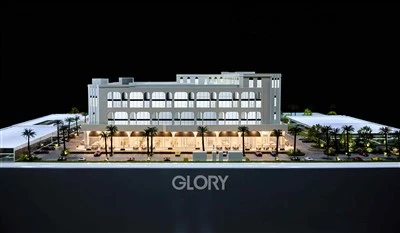
As real estate developers, architectural firms and industrial companies include ESG goals in their procurement systems, physical architectural models are increasingly being evaluated as part of the supply chain rather than simply as presentation tools.
In this context, a "sustainable model" should not be defined by one specific material. It should be based on clearer principles: material transparency, efficient material use, structural durability, repairability and lifecycle traceability.
The model-making practices of Glory Models show that a genuinely sustainable approach must balance visual quality, structural reliability, transportation safety and environmental impact instead of relying on a single "green" label.
1. Durability and Material Selection: A Longer Lifecycle Reduces Waste
Material selection directly affects the lifespan and maintenance requirements of an architectural model. For models displayed long-term in sales centres, corporate showrooms or museums, durability is itself a form of resource efficiency.
In Glory Models projects, engineering plastics such as ABS are widely used for structural and exterior components because of their stability and impact resistance. These properties help models withstand long-term display and repeated transportation.
Although ABS is not naturally biodegradable, a durable and repairable model can often be more sustainable than one made from short-life biodegradable materials.
For sustainability-focused projects, practical measures may include:
Optimising internal structures to reduce unnecessary material use
Evaluating recycled-content materials for non-critical components
Using modular structures that allow individual parts to be repaired or replaced
Separating different material types to support future dismantling and recycling
From an ESG perspective, extending a model's service life and avoiding repeated production can help reduce its overall carbon footprint.
2. Digital Manufacturing and 3D Printing: Focus on Material Efficiency
At Glory Models, 3D printing is widely used to produce complex surfaces, industrial equipment and detailed components. Its main value lies in reducing the need for moulds and improving material accuracy.
Common materials include PLA, engineering-grade filaments and photopolymer resin. Although PLA is made from renewable resources, it usually requires industrial composting conditions to break down. It does not necessarily decompose quickly in the natural environment.
From an ESG perspective, the more important questions are:
Has material waste and repeated machining been reduced?
Have the infill rate and printing path been optimised?
Has the need for rework and trial production been reduced?
Are printing waste and uncured materials properly managed?
At Glory Models, the sustainability value of 3D printing mainly comes from on-demand production and reduced overproduction, rather than from the name of the material alone.
3. Adhesives and Assembly: Managing VOCs and Improving Disassembly
Architectural models usually combine several different materials, which makes adhesives difficult to avoid. At Glory Models, adhesive selection is evaluated according to structural strength and the model's indoor display environment.
Within an ESG framework, the key issue is not whether adhesives are used, but how VOC emissions are controlled and whether the model can be disassembled.
Where structural requirements allow, sustainable practices may include:
Evaluating low-VOC or water-based adhesives
Using precise glue application to reduce unnecessary consumption
Replacing permanent bonding with clips, screws or magnetic connections where practical
Allowing sufficient curing and ventilation before packing and shipping
Providing Safety Data Sheets (SDS) to improve supply-chain transparency
Different parts of a model require different levels of strength, and some critical connections may still need industrial-grade adhesives. Glory Models therefore focuses on responsible use and controlled emissions rather than simple replacement.
4. Landscaping and Surface Materials: Balancing Realism and Material Sources
Static grass, flocking and landscape fibres are commonly used to represent greenery in architectural models. At Glory Models, these materials help recreate urban landscapes, gardens and ecological spaces.
Although they look natural, many of these materials are made from synthetic fibres.
Under a sustainable procurement framework, they can be improved by:
Evaluating natural or recyclable fibres for short-term displays
Prioritising stability and durability for long-term installations
Using localised application methods to reduce material waste
Designing modular landscape sections for easier replacement and maintenance
Reviewing quarantine and material compliance requirements before export
It is also important to understand that "natural" does not always mean "lower environmental impact." Transportation, storage and maintenance should also be included in the lifecycle assessment.
5. Waste Reduction: Sustainability Starts with Fewer Revisions and Less Reproduction
Based on Glory Models' experience, the environmental impact of a model comes not only from its materials, but also from design changes, rework, transportation and packaging.
For this reason, decisions made before production are especially important:
Complete the 3D model review and design approval in advance
Confirm colours, lighting and material finishes
Test samples at important project stages
Reduce late-stage changes and repeated production
The model structure can also be improved through:
Modular design for easier assembly, disassembly and maintenance
Standardised LED and electronic components that can be replaced
Maintenance access points that extend the model's service life
Reusable transportation packaging
Reduced use of disposable filling and protective materials
For travelling exhibitions and long-term display projects, these measures often provide greater overall environmental value than simply reducing material use during a single production cycle.
6. ESG-Oriented Procurement: Transparency Before Broad Environmental Claims
In international procurement, more companies are asking suppliers to provide material transparency and traceable information. When working with ESG-focused clients, Glory Models uses verifiable information as the basis of project communication.
For architectural models, this may include:
Listing the main materials used
Identifying optional low-VOC or recycled-content materials
Explaining how different options affect cost, accuracy and lead time
Providing safety and compliance documents, such as SDS
Explaining how the model can be dismantled and maintained
Evaluating whether the packaging can be reused
Within an ESG framework, verifiable information is more valuable than broad claims that a product is "completely environmentally friendly."
Conclusion
The goal of sustainable architectural model making is not to depend on the "green" qualities of one material. It is to improve resource efficiency and reduce waste throughout the model's lifecycle.
The practices of Glory Models show that every stage-from material selection and digital manufacturing to assembly, transportation and maintenance-can be improved through transparent communication and considered design.
By discussing material options, service life, display conditions and maintenance requirements with clients at the beginning of a project, Glory Models can provide a more transparent, controlled and ESG-aligned model-making solution without compromising visual quality or structural performance.